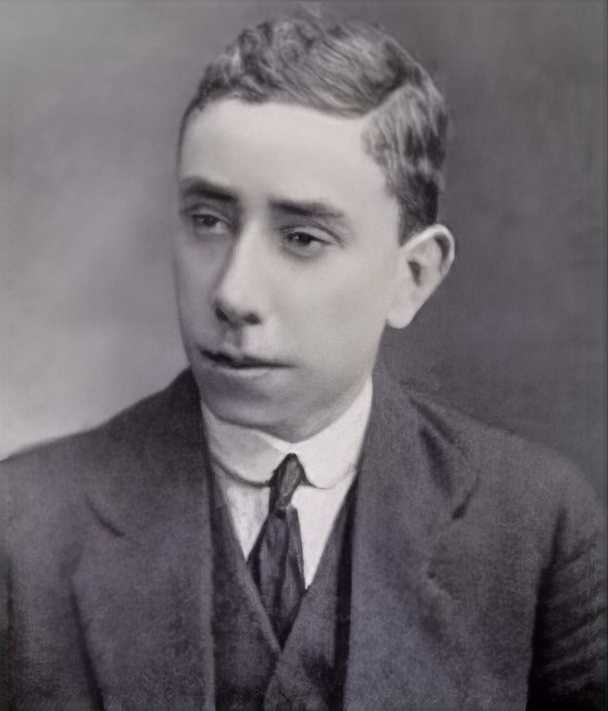

John North Davis
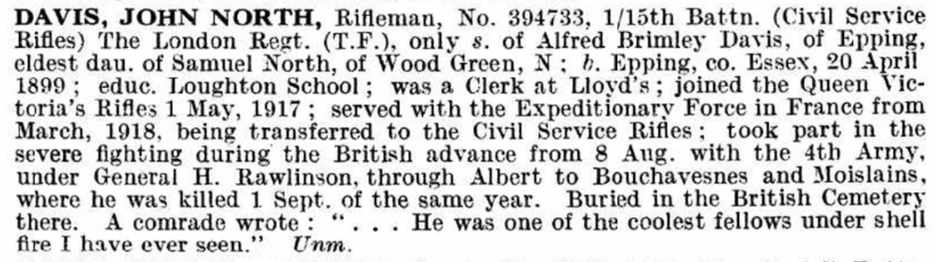
John North Davis, a rifleman (394733), served with the 9th Battalion, London Regiment, attached to the 1/5th Battalion, London Regiment. He died on September 1st, 1918, aged 19, having witnessed some of the most bitter and famous battles of the First World War. He is commemorated at the Peronne Communal Cemetery Extension in the Somme. He was the son of Alfred Brimley Davis (the proprietor of the West Essex Gazette) and Ethel Davis, of 1 Bower Hill, Epping.
He was born in Epping on 20th April 1899 and educated at Loughton School, after which he became a clerk at C.E. Heath & Company at Lloyd’s. He enlisted on 1st May into the 9th Battalion (Queen Victoria Rifles) of the London Regiment. He later transferred to the 1st / 5th and served under the 4th Army, commanded by General H. Rawlinson, during the British advance of 1918. The advance moved through Albert to Bouchavsenes and Moislains, where he was killed in action. A comrade wrote, “…he was one of the coolest fellows I have ever met.”
He enlisted in London with the 9th Battalion, London Regiment (Queen Victoria’s Rifles), on 1st May 1917 and served in France from March 1918. The 9th Battalion had been part of the original Expeditionary Force. John was later attached to A Company, 1/15th (County of London) Battalion (Prince of Wales’ Own Civil Service Rifles), and saw action in the British offensive on 8 August 1918. On 1 September 1918, the 1/15th (County of London) Battalion (Prince of Wales’ Own Civil Service Rifles) was tasked with attacking the enemy-held village of Rancourt.
The Moislains area in northern France was significant during this period, as it lay on the front line where several battles were fought. The village of Moislains was near the Hindenburg Line, a major German defensive position. The British forces aimed to breach this line, making Moislains strategically important to their operations.
The battalion assembled for the attack between the Le Forest-Rancourt Road and the road from Rancourt at Marrieres Wood, about three-quarters of a mile from the village. Despite a few casualties from shelling while moving up to the assembly point, the battalion was in place at 5 am, with the attack scheduled for 5.30 am. C and D Companies were to lead the attack, with A and B Companies in support.
Following a five-minute bombardment by supporting artillery, the lead companies of the battalion advanced at the appointed hour. The attack was highly successful, with prisoners being sent down the line within ten minutes of the advance. By 7.30 am, all objectives had been taken and were being consolidated. While consolidating their gains, B and D Companies came under fire from a German field gun firing over open sights, causing several casualties. The battalion also repelled a counterattack on their right flank with Lewis gun and rifle fire. They were relieved at 11.30 pm, having captured 150 enemy prisoners during the day. A comrade wrote of John: “He was one of the coolest fellows under shell fire I have ever seen”. John is buried at Peronne Communal Cemetery, Extension Plot I, Row C, Grave 43.