
Ernest Harold Marden Gumprecht
Ernest Harold Marden Gumprecht was the son of Mr Ludwig William Edward Gumprecht and Fanny Margaretta Gumprecht. They lived in Leyton. The 1901 census shows them as being in the Lea Bridge Urban District. By 1911, they had moved to “The King’s Oak”, High Beech, Loughton. (The census forms state it was the King’s Head, but there has not been a pub of that name in High Beech, so it must mean the King’s Oak.)
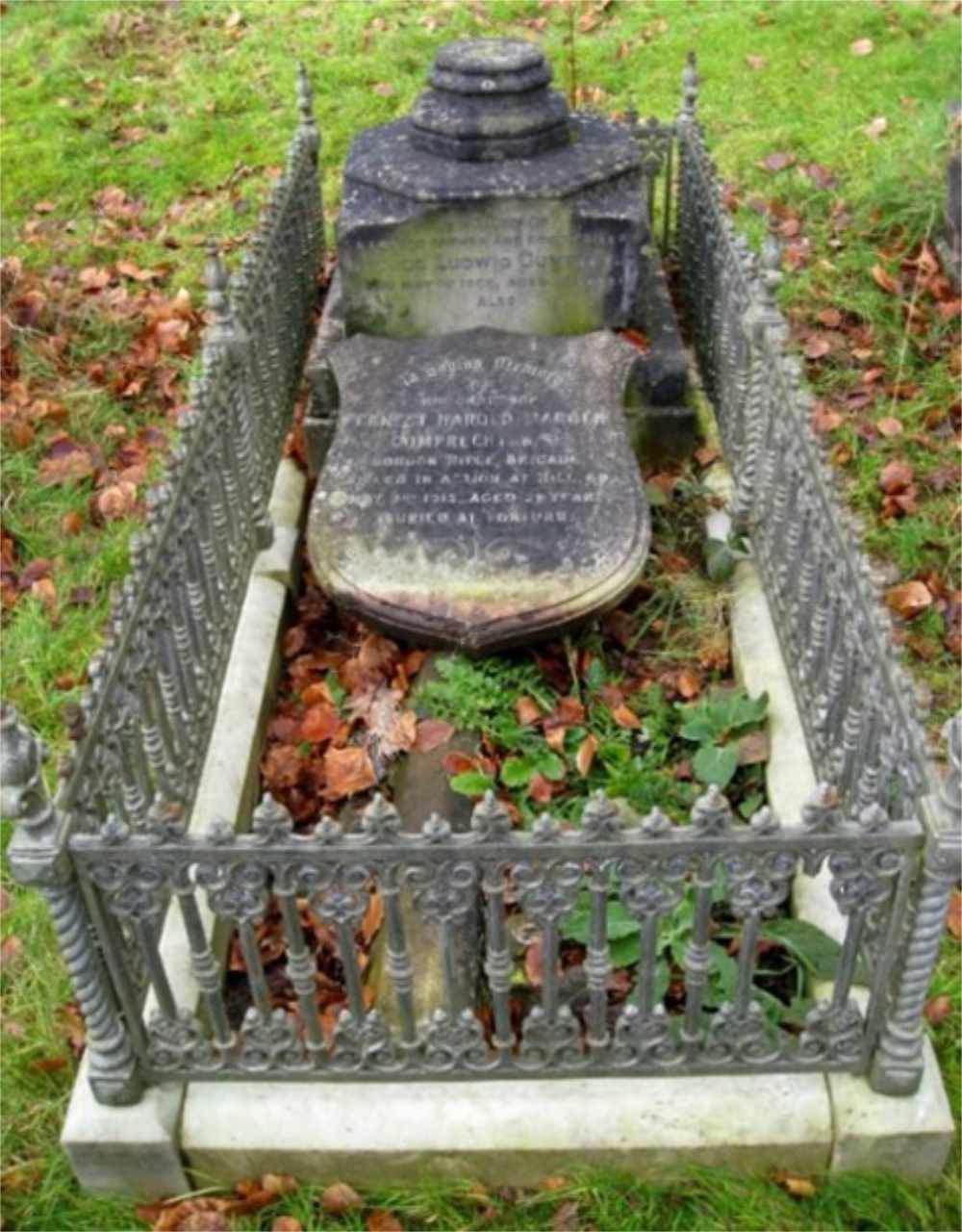
Born June 3rd 1894, he was a rifleman with the 1st Battalion, London Rifles. He died on the 3rd May 1915, aged 21, on “Hill 60”. He was baptised on June 3rd 1894, at St Peter and Paul church in Chingford. Later, they moved to the King’s Head pub in High Beech.
Earnest gained a BSc. and became an actuary and worked for the Pearl Assurance Company.
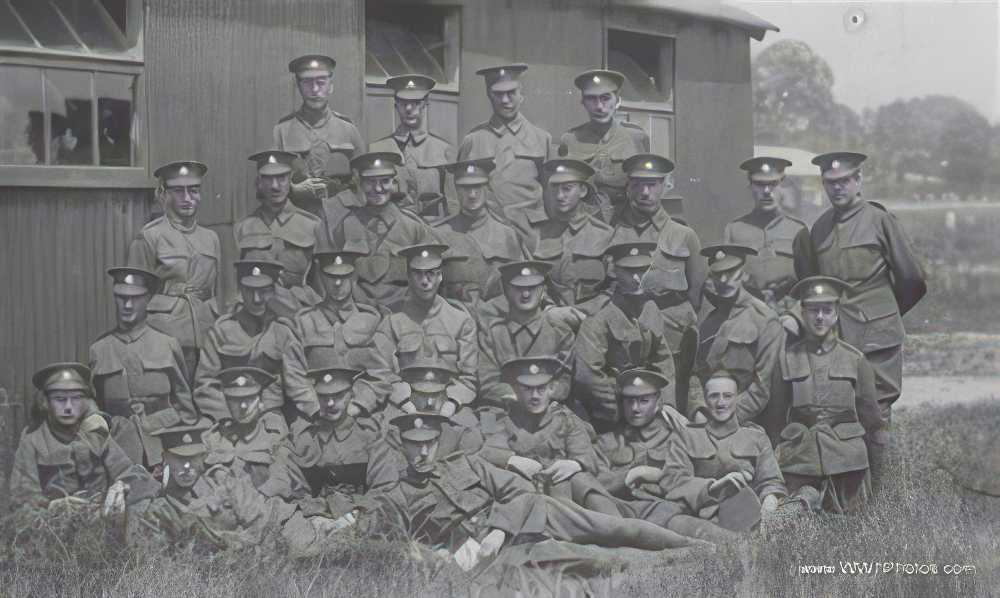
The London Rifle Brigade crossed to France in November 1914 as part of the British Expeditionary Force, joining the 11th Brigade, 4th Division, serving in the trenches. The men participated in the Christmas Truce in December 1914. They fought at the second battle of Ypres, April – May 1915. They lost sixteen officers and 392 men. One was awarded the V.C.
There is no mention in the following report on the capture of Hill 60 that the London Rifle Brigade, or the 4th Division, was involved. However, the report does state that at one point it was necessary to call on all reserves to help; it is not noted which these were. It is also possible that the London Rifles were one of them, as they would have been close by. Whatever the case, Ernest certainly lost his life in this action. The 5th London Regiment was at Ypres for the Second Battle of Ypres (22nd April – 25th May 1915), which is nearby.
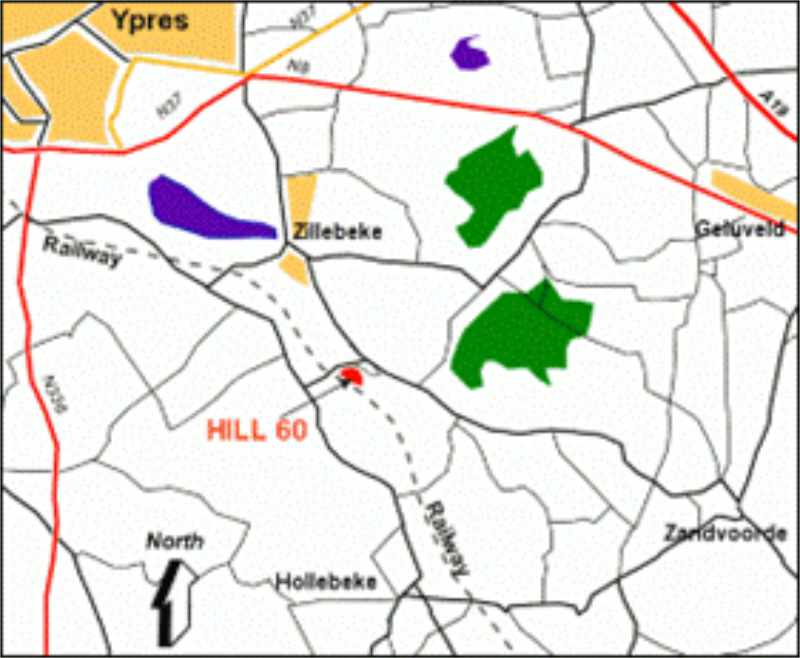
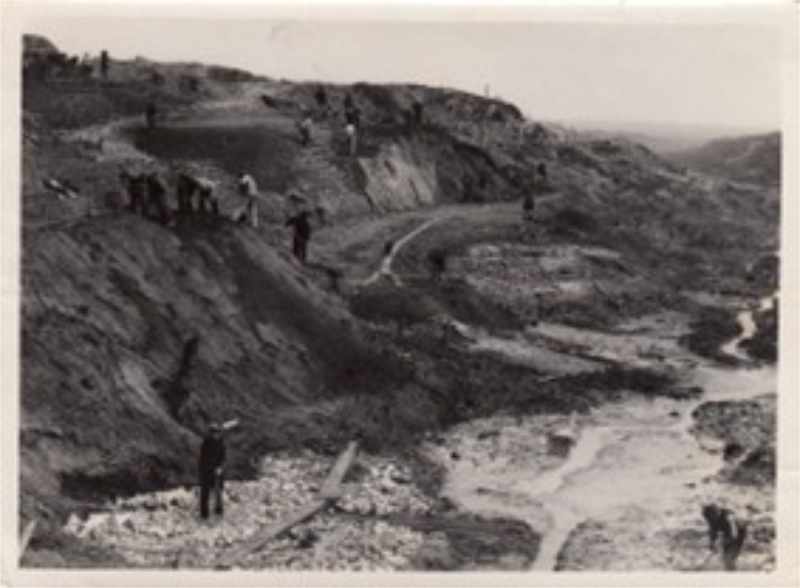
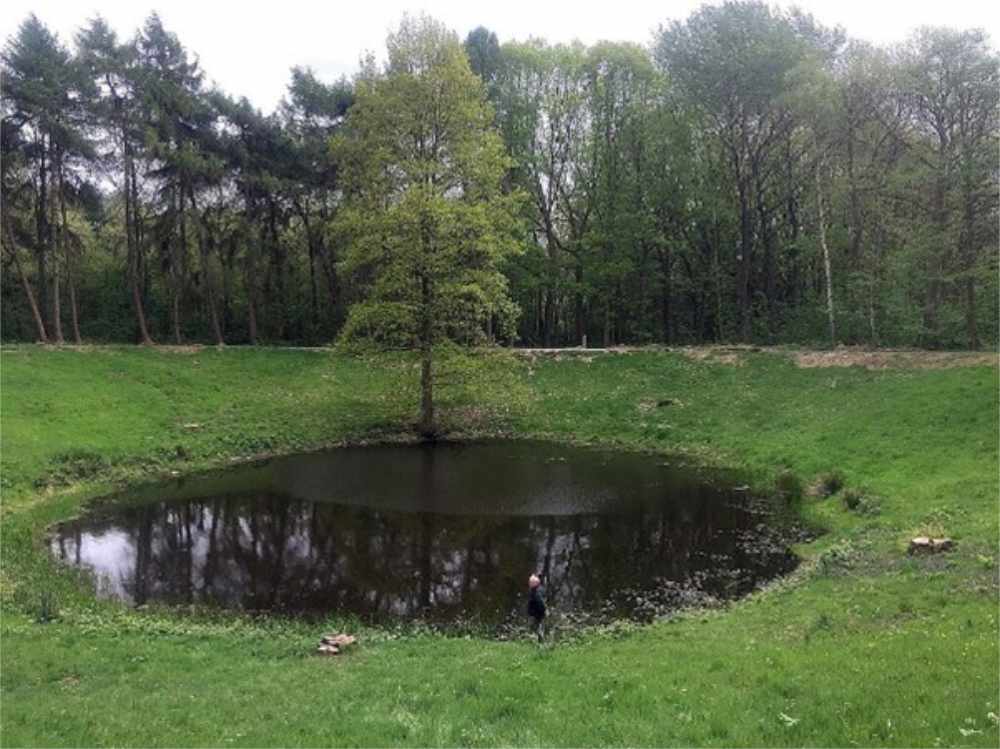
Hill 60 was a low-rise hill south-east of Ypres made from the soil removed in digging a cutting for the Ypres to Comines railway. It had excellent views over both Ypres and Zillebeke, and was captured by the Germans during the first Battle of Ypres in November 1914. On 17th April 1915, in one of the first tunnelling operations by the British Army, six mines were exploded under Hill 60, which was then quickly captured with minimal casualties. But, in early May, the Germans recaptured the hill with the use of gas.
An ambitious plan to capture the hill was devised, despite advice that Hill 60 could not be held unless the nearby Caterpillar Ridge was also occupied.
The following report details the action taken at Hill 60 to recapture it. This occurred between 17th and 21st April 1915.
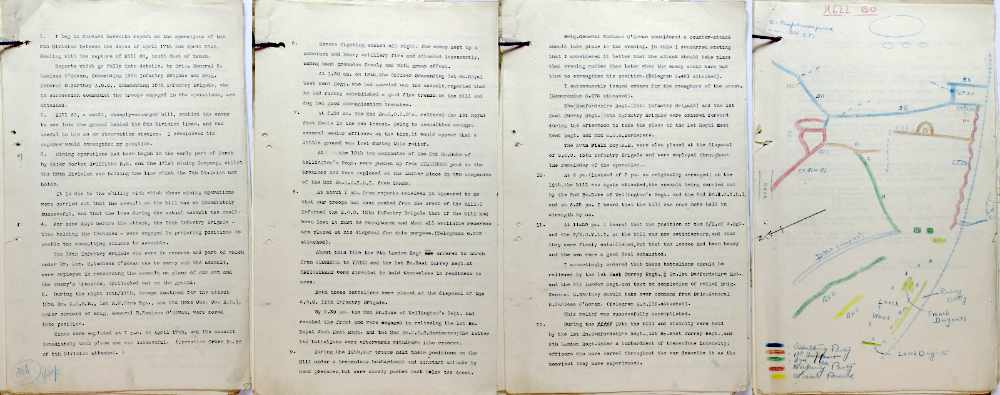
“1. I beg to go forward herewith report on the operations of the 5th division between the dates of April 17th and April 21st, dealing with the capture of Hill 60, south East of Ypres. Reports which go fully into details, by Brig. General R. Wanless O’Gowan, Commanding 13th Infantry Brigade and Brig. General E. Northey A.D.C., Commanding 15th Infantry Brigade, who in succession commanded the troops engaged in the operations, are attached.
2. Hill 60, a small, steeply-escarped hill, enabled the enemy to see into the ground behind the 5th Divisional lines, and was useful to him as an observation station. I consider its capture would strengthen my position.
3. Mining operations had been begun in the early part of March by Major Norton Griffiths R.E. and the 171st Mining Company, whilst the 28th Division was holding the line which the 5th Division now holds. It is due to the ability with which these mining operations were carried out that the assault on the hill was so immediately successful, and that the loss during the actual assault was small.
4. For some days before the attack, the 15th Infantry Brigade – the holding the trenches – were engaged in preparing positions to enable assaulting columns to assemble. The 13th Infantry Brigade who were in reserve and part of which under Br. Gen. R. Wanless O’Gowan was to carry the assault, were employed in rehearsing the assault on plans of our own and the enemy’s trenches, spitlocked out on the ground.
5. During the night 16th/17th, troops destined for the attack (2nd Bn. K.O.S.B., 1st R. W. Kent Rgt., and 2nd Home Cos Co. R.E.), under command of Brig. General R. Wanless O’Gowan, were not moved into position. Mines were exploded at 7p.m. on April 17th, and the assault immediately took place and was successful. (Operation Order, No. 50 of 5th Division attached).
6. Severe fighting ensued all night. The enemy kept up a constant and heavy artillery fire and attacked incessantly, using hand grenades freely and with great effect. At 1.30 a.m. on 18th, the Officer Commanding 1st Bn. Royal West Kent Regt., who had carried out the assault, reported that he had firmly established a good fire trench on the hill and dug two good communication trenches.
7. At 3.30 am. The 2nd Bn. K.O.S.B’s. relieved the 1st Royal West Kents in the new trench. Owing to casualties amongst several senior officers at the time, it would appear that a little ground was lost during this relief. At 5.30 am., the 18th two companies of the 2nd Bn. Duke of Wellington’s Reg. were pushed up from ZILLEBEKE pond to the trenches and were replaced at the latter place by two companies of the 2nd Bn. K.O.Y.L.I. from Ypres.
8. At about 7 am., from reports received it appears to me that our troops had been pushed from the crest of the hill. I informed the G.O.G. 13th Infantry Brigade that if the hill had been lost it must be recaptured and that all available reserves are placed at his disposal for this purpose. (Telegrams G.393 attached). About this time the 9th London Regt. Was ordered to march from OUDEROM to YPRES and the 1st Bn. East Surrey Regt. At KRUISSTRAAT were directed to hold themselves in readiness to move. Both these battalions were placed at the disposal of the G.O.C. 13th Infantry Brigade. By 7.30 am, the 2nd Bn. Duke of Wellington’s Regt., had reached the front and were engaged in relieving the 1st Bn. Royal West Kent Regt., and the 2nd Bn. K.O.S. Borderer’s; the latter two battalions were afterwards withdrawn and into reserve.
9. During the 18th, our troops held their positions on the hill under a tremendous bombardment and constant attacks by hand grenades, but were slowly pushed back below the crest. Brig. General Wanless O’Gowan considered a counter-attack should take place in the evening. In this I concurred, stating that I considered it better that the attack should take place that evening rather than later when the enemy could have time to strengthen his position. (Telegram G.461 attached).
I subsequently issued orders for the recapture of the crest. (Memorandum G.475 attached). The Bedfordshire Regt. (14th Infantry Brigade) were ordered forward during the afternoon to take the place of the 1st Royal West Kent Regt. and 2nd K.O.S. Borderer’s.
The 59th Field Coy. R.E. were also placed at the disposal of G.O.C. 13th Infantry Brigade and were employed throughout the remainder of the operation.
10. At 6 p.m. (instead of 5 p.m.as originally arranged) on the 18th, the hill was again attacked, the assault being carried out by the 2nd Bn. Duke of Wellington’s Regt. and the 2nd Bn. K.O.Y.L.I. and at 6.55 p.m. I heard the hill was once again more held in strength by us.
11. At 11-30 p.m. I learnt that the position of the 2/D, of W. Regt. and the 2/K.O.Y.L.I. on the hill was now satisfactory, and that they were firmly established, but that the losses had been heavy and the men were a good deal exhausted.
I accordingly ordered that these battalions should be relieved by the 1st East Surrey Regt. 1/2 Bn. 1st Bedfordshire Rgt. And the 9th London Regt. and that on completion of relief Brig. General E. Northerly should take over command from Brig. R. Wanless O’Gowan (Telegram G.A. 116 attached).
This relief was successfully accomplished.
12. During the 19th the hill and vicinity were held by the 1st Bn. Bedfordshire Regt., 1st Bn. East Surrey Regt. and 9th London Regt. under a bombardment of tremendous intensity; officers who have served throughout the war describe it as the heaviest they have experienced.”
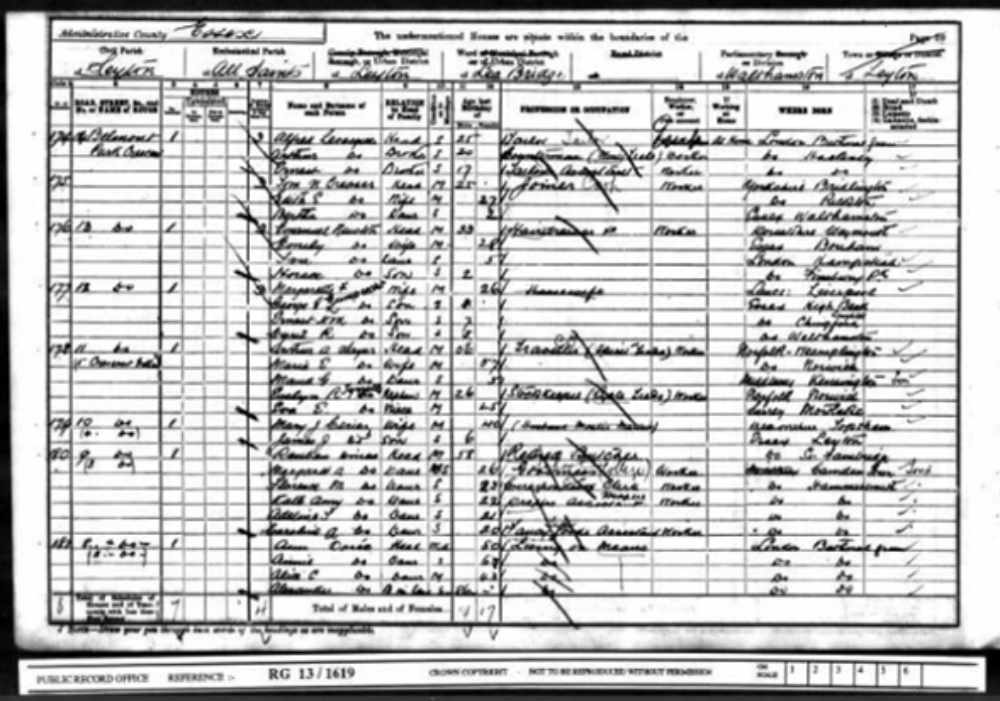
The 1901 census shows the family living at Belmont Park Crescent, Leyton. His father is not recorded on the census. His mother Margareta is listed but not marked as head of the household; she is 26 years old. They have three sons: George, aged 2; Ernest, aged 7; and Cyril, aged 5.
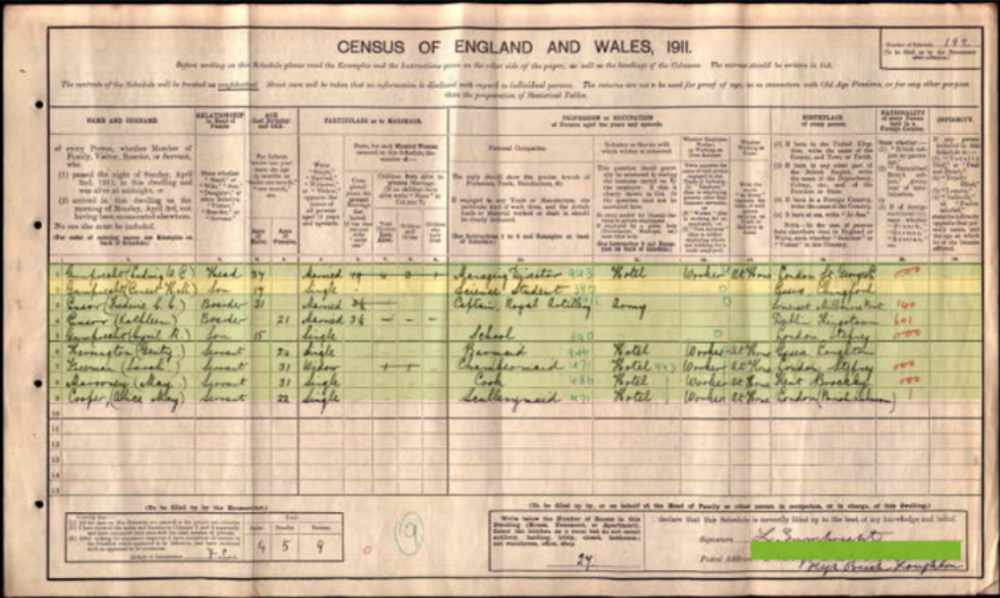
The 1911 census shows they were living at the Kings Head Hotel, High Beech. The head of the household was Ludwig William Edward Gumprecht, aged 37 and married, noted as a managing director. He was involved in the hotel industry, so he possibly owned the Kings Head. His wife is not listed on this census. Also listed was Ernest Hall Gumprecht, aged 17, single, shown as a science student. The census also includes Frederick C. C. Ensor, a 31-year-old boarder and married, a captain with the Royal Artillery; along with his wife Kathleen, aged 21, who had been married for 2½ years. The following individuals were all listed as servants, but are likely the hotel staff: Harrington Gentry, 24, single; Sarah Freeman, 31, a widower; May Marooney, 31, single; and Alice May Cooper, 22, also single.
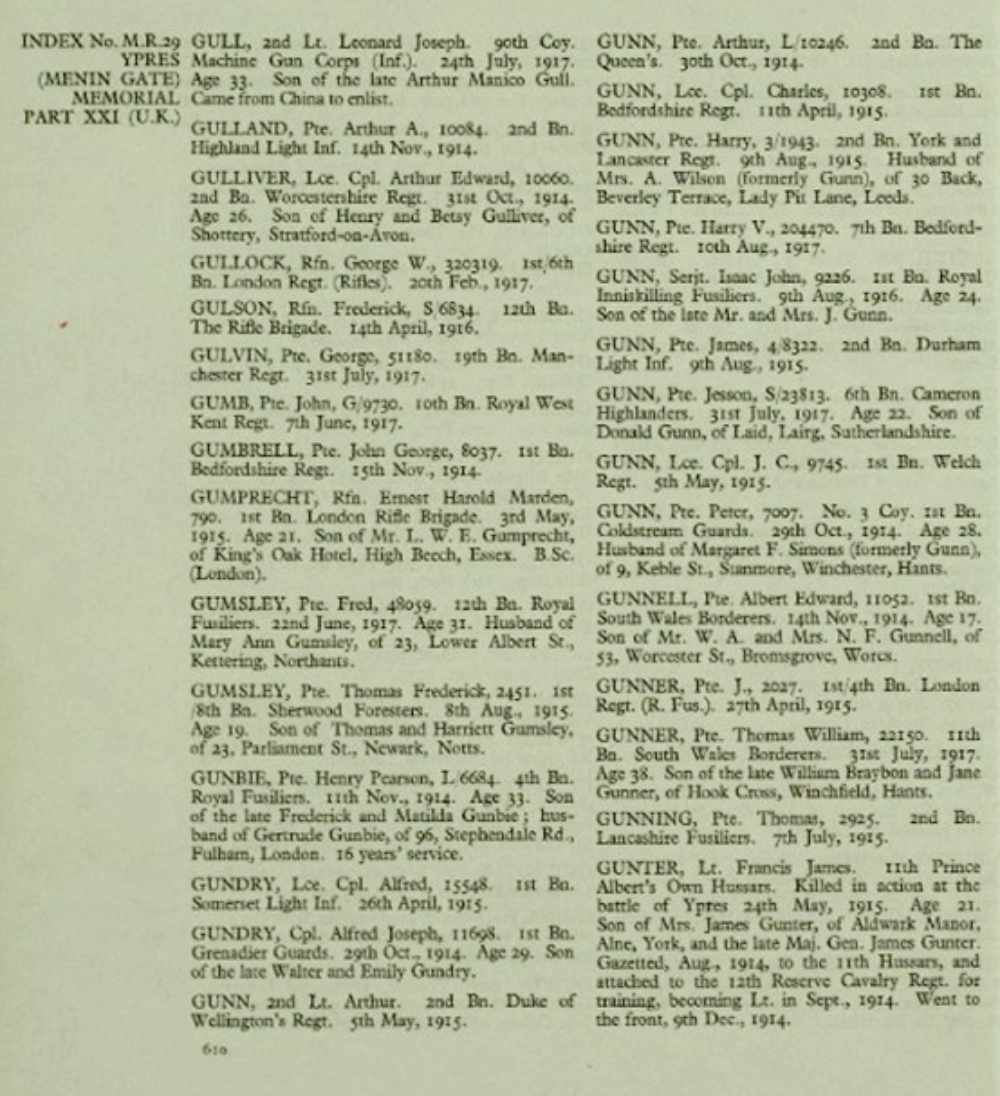
He is also remembered on the Ypres (Menin Gate) Memorial.
The inscription says he died at Hill 60.