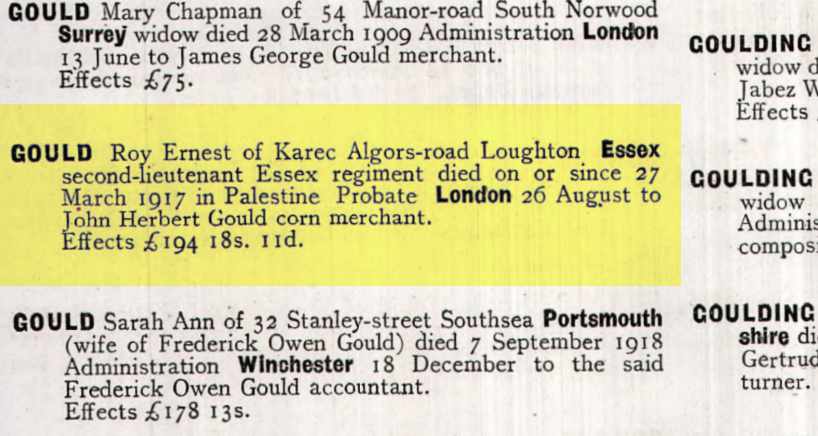

Roy Ernest Gould
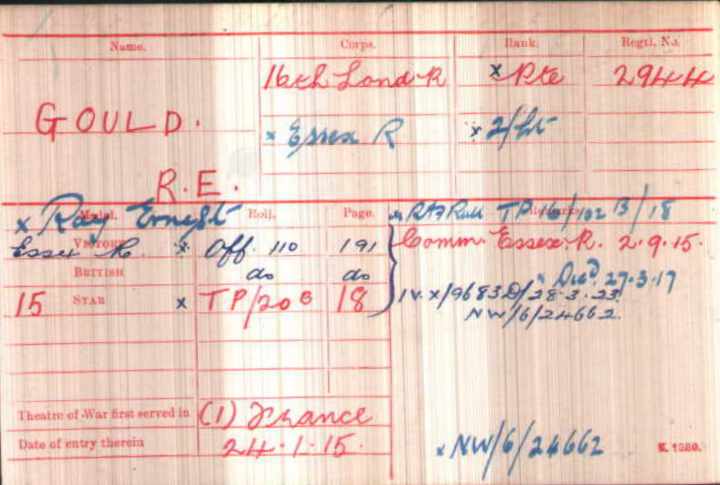
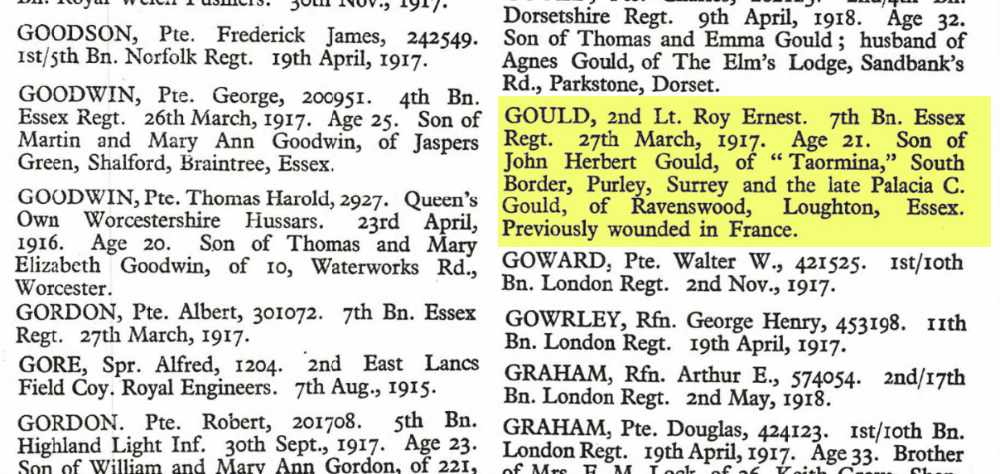
Roy Ernest Gould was born in 1896, the son of John Herbert Gould of “Taormina,” South Border, Purley, Surrey, and Palacia C. Gould of “Ravenswood.” He died in Jerusalem on 27th March 1917.
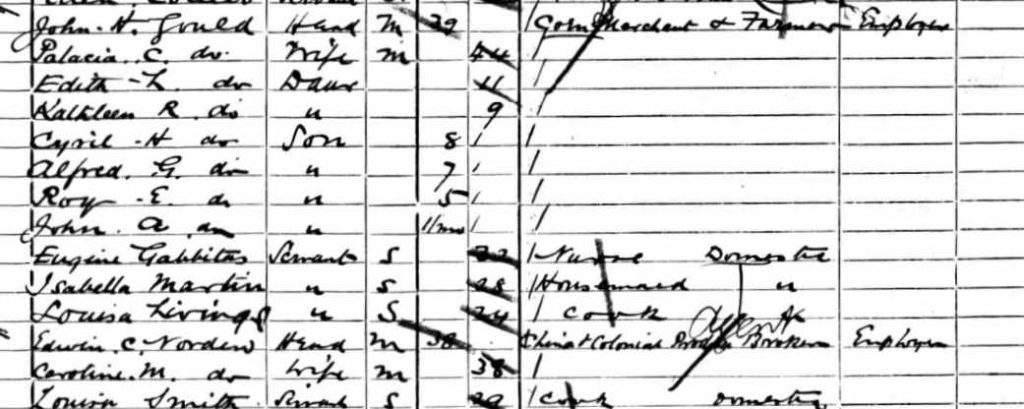
In 1901, aged 5, he was recorded as living in Upper Park Road, Loughton. He had five siblings. He was baptised at St Mary’s Church, Theydon Bois, Essex, on 10th May 1896. He is a cousin of Stanley Ernest Gould, who is also remembered in a separate article.
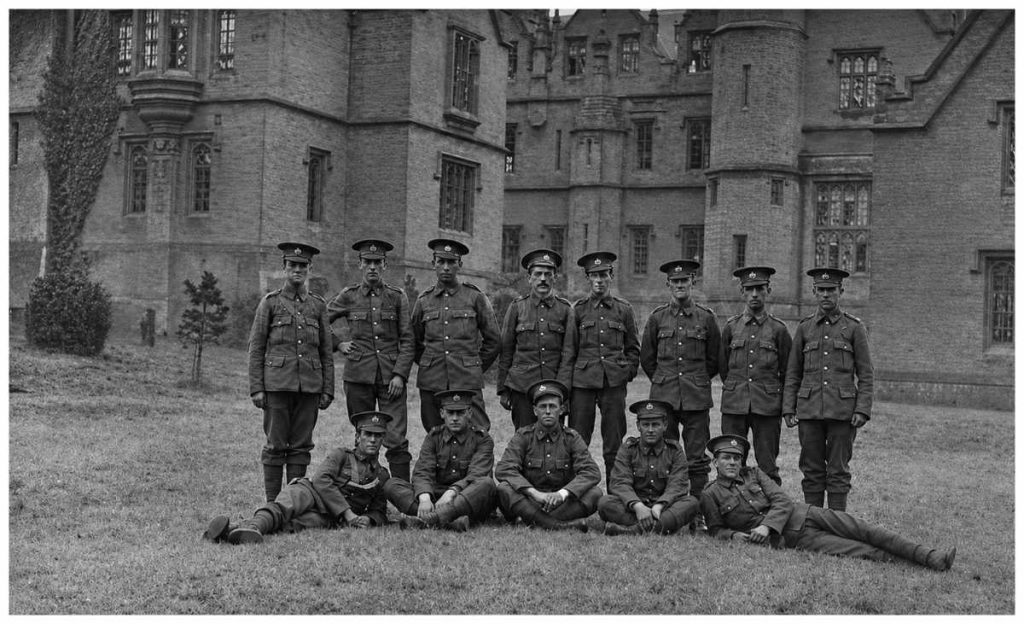
Roy was a 2nd Lieutenant in the 7th Battalion, Essex Regiment. He had previously been wounded in France. The 7th Battalion, Essex Regiment, was a unit of the Territorial Force based at Walthamstow Lodge, Church Hill, Walthamstow. “A” to “G” Companies were situated in Walthamstow, with a Cadet Force located at 26 Chester Road, Walthamstow.
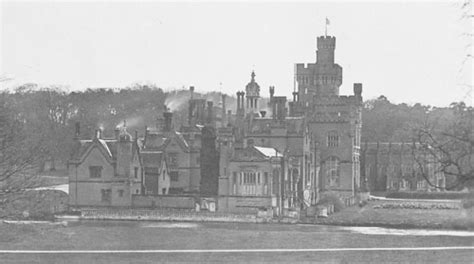
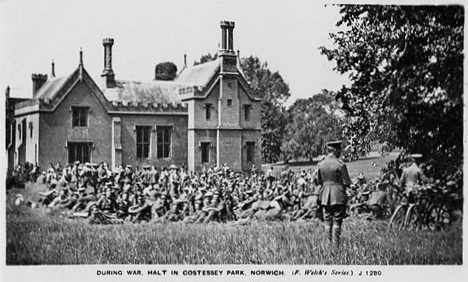
The East Anglian Division was a week into its fortnights annual training at Clacton when the order to mobilise arrived on 4th August 1914. The units immediately proceeded to their designated war stations along the East Anglian coast, with the 7th Essex at Felixstowe. They were relieved on 9th August to return to Walthamstow to muster, and by 10th August the division was concentrated around Brentwood, with the 7th Battalion headquarters at the Golden Fleece Inn. The 7th later moved to the cavalry barracks in Norwich, then to Costessey Hall, four miles north of Norwich.
After serving in home defence, the Essex Brigade—which included the 4th, 5th, 6th, and 7th Battalions and was later named the 161st (Essex) Brigade in the 54th (East Anglian) Division—landed at Suvla Bay in August 1915, attempting to restart the stalled Gallipoli Campaign. The four Essex battalions faced significant fighting and suffered heavy casualties from sickness. They were withdrawn to Egypt in December before the Gallipoli Peninsula was finally abandoned.
The Gallipoli Campaign had been in progress for several months and had reached a stalemate. A fresh Landing at Suvla Bay on 6 August 1915 was intended to turn the flank of the Turkish positions on the Gallipoli Peninsula and drive inland. The operation was bungled, and the 54th Division, as the last remaining reserve, was landed to drive through, but was used merely to shore up the position. The Essex battalions arrived still under strength, and armed with obsolete long Lee-Enfield rifles – many soldiers exchanged these for modern SMLE (Short Magazine Lee-Enfield) weapons picked up from the casualties.
7th Essex advanced directly to the reserve line when the 161st Brigade relieved the 163rd (Norfolk & Suffolk) Brigade for an attack. The 161st Brigade’s involvement was cancelled, but on the afternoon of 14th August the brigade moved over open ground to relieve the Norfolks and Suffolks after their disastrous attack. The Essex Brigade’s historian notes that ‘Though they were met with a fusillade as they advanced steadily over the plain, there was no hesitation.’ They reached the line and spent the entire night consolidating the position, with the 7th suffering 25 casualties during the advance.
Next, the battalion moved to the Hill 60 sector, which one officer described as ‘notoriously one of the most unpleasant spots on the peninsula’. It was attached to the 163rd Brigade to prepare for an attack to capture the rest of the hill, where opposing trench lines were only 17 yards apart, and sappers on both sides were digging mines. The operation was repeatedly postponed: although the 7th Essex was the strongest battalion in the 163rd Brigade, its battle casualties averaged about 50 a month, with a much higher proportion of the force sick in hospital. The 7th Battalion received a draft of 2 officers and 70 other ranks in early November, but it was insufficient. The already weakened brigade was too feeble to mount even a minor attack. The British mines were finally detonated on 14th November, and a 100-strong party from the 7th Battalion was tasked with seizing the crater. However, the trenches were blocked by debris, and the attack was abandoned. On 24th November, a Turkish mine exploded under ‘Essex Barricade’, killing eight and wounding ten of the battalion.
At the First Battle of Gaza (26th March 1917), the main assault was carried out by the 53rd (Welsh) Division, supported by the 161st Brigade. Towards the end of the day, the Essex Brigade was ordered to seize Green Hill: despite fierce fighting, the attack succeeded completely, and the brigade held the entire position by nightfall. However, confusion arose, and the 53rd Division withdrew during the night. The men of the 161st Brigade were furious about the order to withdraw. The next day, patrols confirmed that the Turks had not reoccupied the position; the 7th Battalion was dispatched to support the patrols, but a fierce Turkish counter-attack ended the battle. The battalion’s casualties at Green Hill numbered 228, with 68 missing after the fighting withdrawal. It was here that Ernest likely lost his life.
Further information appears to be held by the Israel Genealogy Research Association (IGRA), but I have been unable to gain access to their files so far. I will continue to try.
Jerusalem Memorial Register