

Kenneth Garnet Ford
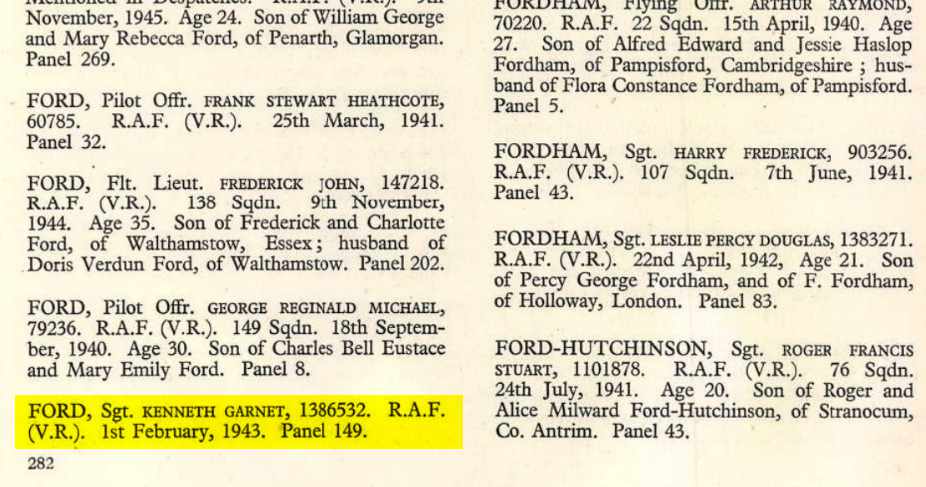
Sergeant 1386532 Kenneth Garnet Ford was born in 1922 in West Ham. His RAF service number can help narrow his enlistment date, as numbers were issued in blocks: those in the 1386xxx range were typically issued around 1940–1941. This suggests he likely enlisted early in WWII.
So far, I have failed to find his family history. The 1911 and 1921 censuses were taken. The 1931 census was destroyed in the Blitz, and no census was taken in 1941. Therefore, anyone born after the 1921 census, which was taken in June that year, will not appear. This is the case, as Kenneth was born in 1922.
He was a member of the Royal Air Force Reserve and served in 3 (C) OUT (Operational Unit Training). No. 3 Operational Training Unit RAF was a training unit of the Royal Air Force within No. 17 Group RAF, which was part of RAF Coastal Command. The unit began operating in late 1940 and disbanded at the start of 1944, when it was absorbed into No. 6 OUT.
He was a pilot of a Wellington Bomber. Believed to have ditched in the North Sea about 40 miles east of Scarborough, Yorks, after reporting an Oil Leak during a daylight navigational exercise. He died on 1st February 1943. He is remembered on the Runnymede Memorial, Surrey, panel 149.
Source:
AWM 237 (65) NAA : A705, 166/24/25 Commonwealth War Graves records
Aircraft Type: Wellington VIII
Serial number: LB 222
Radio call sign:
Unit: 3 Op Training RAF
Summary:
On 1st February 1943, Wellington LB222 took off from RAF Cranwell at 10:22 hours for a daytime non-operational navigational training flight. At 11:15 hours, a message was received that the aircraft was returning to base due to an oil leak. Its position at the time was 54.42N, 01.58E. At 12:30 hours, a fix was obtained, and at 12:45 hours, the aircraft sent an SOS, indicating a position of 54.36N, 00.49E. After that, no further communication was received from the aircraft, which failed to return to base. There was no indication of why the aircraft had ditched. The sea was relatively calm, and a thorough search was carried out, but yielded no results.
LB222 did not complete its return to base and was lost over the North Sea. The precise cause (for example, mechanical failure or weather conditions) is not definitively recorded in the available official accident summaries, which si mply list it as an aircraft accident, with the personnel listed as missing and believed killed.
As was standard for such training flights, it was not an operational combat mission but a navigational exercise — a common flight used to prepare crews for the demands of wartime flying.
Crew:
RAF Sgt K G Ford, (1st Pilot)
RAF Sgt G Overhill, (2nd Pilot)
RAAF 408524 Sgt S J Lloyd, (Observer)
RAF Sgt P J Smith, (1st Wireless Operator)
RAF Sgt E B Parr, (Front Gunner)
RAF Sgt L C Trent, (Rear Gunner)
Sgt Lloyd’s body was washed ashore on 28th April 1943, at Knispeand near Norddorf/Aurus Denmark.
He and Sgt Overhill are buried in the Kiel War Cemetery, Germany. Kiel lies 83 km north of Hamburg. The other four crew members lost their lives at sea and have no known grave. Their names are commemorated on the Memorial to the Missing, Runnymede, Surrey, UK.
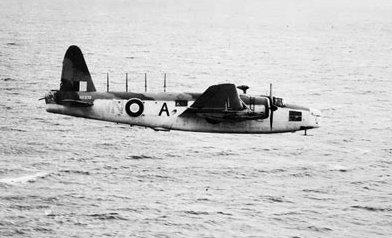
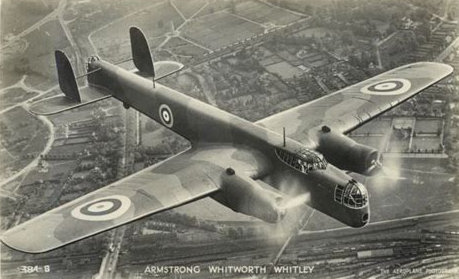
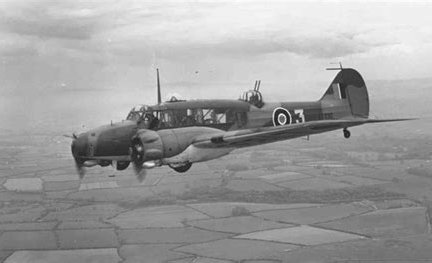
No. 3 (C) OTU was the first unit officially based at RAF Haverfordwest. Initially, on 30th November 1942, four of its Armstrong Whitworth Whitley aircraft, along with ground crew, moved in from RAF Cranwell. Its role was to provide aircrew with reconnaissance training, and by June 1943, its full complement of aircraft had arrived. Around the end of April 1943, aircrew training for Armstrong Whitworth Whitley had concluded, and the unit reorganised its flights. The Vickers Wellington conversion training was designated ‘A’ Flight, with the two Operational Training flights ‘B’ Flight and ‘D’ Flight. ‘C’ Flight was responsible for the training of Avro Anson aircrew.
No. 3 (C) OTU’s Armstrong Whitworth Whitley aircraft were eventually withdrawn and replaced by more Vickers Wellington aircraft. Due to limited space at RAF Haverfordwest, ‘O’ Flight operated from RAF Haverfordwest’s satellite airfield, RAF Templeton. ‘O’ Flight was equipped with fourteen Avro Anson I aircraft and tasked with training aircrew for general reconnaissance, especially in the use of Leigh Lights. RAF Coastal Command successfully employed these lights against Kriegsmarine submarines. The flight left RAF Templeton in December 1943, relocating to RAF St Athan, where it was renamed No. 12 Radio School RAF.
The unit was disbanded on 4th January 1944 at RAF Haverfordwest and absorbed by No. 6 Operational Training Unit RAF (6 OTU).